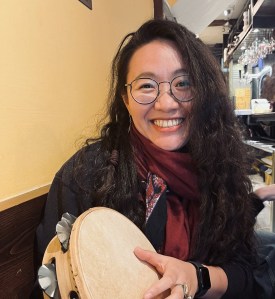
Yulong Huang
Cognitive Neuroscientist | Experimental Psychologist | Art-Science Communication | Documantory filming


Bio
My current position
I hold an M.Sc. in General Psychology (2021, South China Normal University) and am currently a Ph.D. student in Cognitive Neuroscience at the Department of Experimental Psychology, Ghent University. I work under the supervision of Prof. Dr. Lara Bardi at the Social & Cognitive Neuroscience Lab.
About me
My academic path is shaped by an interdisciplinary background. Before entering the field of neuroscience, I studied journalism and documentary filmmaking in South China, where I developed a deep interest in exploring society through individual narratives. This early experience continues to shape my scientific work, encouraging me to ask nuanced questions about human behavior and cognition.
My research investigates how our brains represent and respond to the world around us—especially the subtle social and environmental cues that influence our actions, often without us realizing it.
I’m particularly interested in the power of both social and non-social cues that guide our behavior: i) how learned associations can unconsciously drive our decisions (Pavlovian biases), ii) how perceptions of social dominance and hierarchy influence our decision-making during interpersonal interactions (Facial perception), and iii) how we mentally represent ourselves and others in social contexts (Perspective taking). These questions converge around a central theme: how do we navigate complex social environments, and what are the neural systems that make this possible? To investigate these questions, I use a multi-method approach that includes fMRI, EEG, eye-tracking, and intranasal oxytocin administration—methods that allow me to map the interplay between brain, behavior, and both social and non-social contexts.
Driven by my cross-disciplinary background, I’m also passionate about bridging science and art. As co-founder of NeuroNarratives, an art-science residency initiative, we work to create space where neuroscience and art come together to make research more human, accessible, and resonant.


“However much we are affected by the things of the world, however deeply they may stir and stimulate us, they become human for us only when we can discuss them with our fellows. Whatever cannot become the object of discourse – the truly sublime, the truly horrible or the uncanny – may find human voice through which to sound into the world, but it is not exactly human. We humanize what is going on in the world and in ourselves only by speaking of it, and in the course of speaking of it we learn to be human.”
— Hannah Arendt, Men in Dark Times
 huang Yulong 黃于龍